
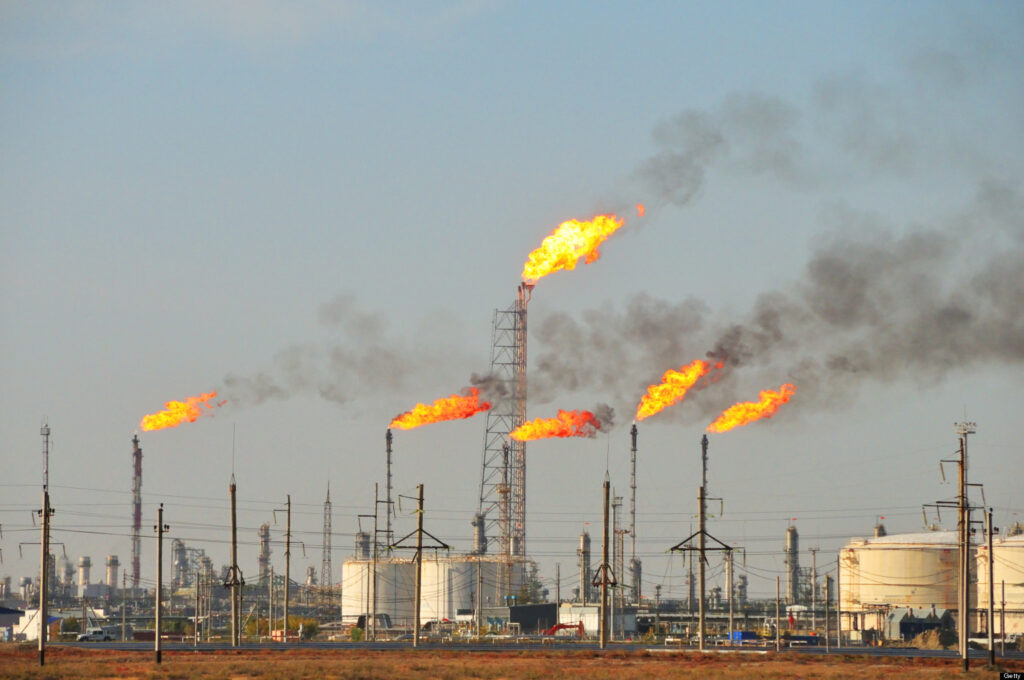
The World Bank says that nearly 30 billion cubic meters of gas produced from Iran’s oil fields were flared and wasted at the production stage last year.
This amount is equivalent to more than 10% of the country’s total gas production and also equals 65% of Iran’s total residential natural gas consumption last year.
According to the Statistical Center of Iran, the residential sector consumed 46 billion cubic meters of natural gas last year.
Alongside Russia, Iran has the worst record in the world for flaring associated petroleum gas.
Over recent decades, the Islamic Republic has made little progress in installing facilities to capture associated gas produced alongside crude oil, instead burning and wasting it at the production stage.
Previously, the Iran Open Data center estimated, based on official Iranian and World Bank statistics, that approximately 203 billion cubic meters of Iran’s produced gas were flared and wasted between 2012 and 2024, with an estimated value of nearly $86 billion.
This enormous volume of gas losses through flaring comes despite former Iranian Oil Minister Bijan Zangeneh stating that only $5 billion in investment would be required to eliminate gas flaring.
World Bank data show that gas flaring in Iran has nearly doubled over the past five years. With only a marginal difference from Russia, Iran now ranks among the world’s worst performers, while Iraq ranks third.
The report adds that total global gas flaring last year—even including liquefied natural gas (LNG) operations—amounted to about 166 billion cubic meters, more than half of which came from Russia, Iran, and Iraq. They were followed by Venezuela, Mexico, and Libya.
Detailed World Bank statistics also show that Iran flared 19.5 cubic meters of associated gas for every barrel of oil produced. By comparison, the figure is 1 cubic meter per barrel in the United States and only 0.7 cubic meters per barrel in Saudi Arabia.
The original article was published on VOA Persian