
The rial’s slide has fueled inflation and eroded living standards in Iran through months of war and a U.S. naval blockade. It has also flattered the government’s books, lifting central bank profits and shrinking domestic debt as a share of the economy, while raising the toman value of what the state owes in foreign currency.
Over the past year, the U.S. dollar has risen more than 150% against the rial, and nearly 430% over three years. That means the rial has lost more than 60% of its value in 12 months and about 80% in three years.
The Central Bank of Iran posted a net profit of about 77 trillion tomans over the past year, according to an audit report by the Supreme Audit Court. Much of it came from selling foreign currency, gold bullion and coins on the domestic market at market rates.
Those sales draw on the gap between exchange rates. The official subsidized rate is pegged near 186,000 tomans to the dollar, while the free market trades above 270,000 tomans, more than 45% higher.
Inflation has also held down the government’s debt ratio. Rial-denominated central government debt grew 12.6% in spring 1405 (Q1) to 311 trillion tomans, according to quarterly figures from the Finance Ministry’s Directorate for Public Debt Management and Government Financial Relations. Debt of state-owned enterprises rose 20% to more than 7 trillion tomans. Because inflation pushed nominal GDP up faster, central government debt slipped from 6% of GDP at the end of the 1404 fiscal year (March 2025–March 2026) to 5.9% by late spring 1405 (June 2026).
Those figures leave out the government’s largest liability: foreign-currency debt to the National Development Fund of Iran. The fund was set up in 2010 as a sovereign wealth fund to channel oil revenue into private investment, but it has lent heavily to the government to cover budget deficits. Its leadership has warned that the government owes more than $100 billion that it cannot service in cash. Officials have turned to negotiating oilfield development rights to offset the debt.
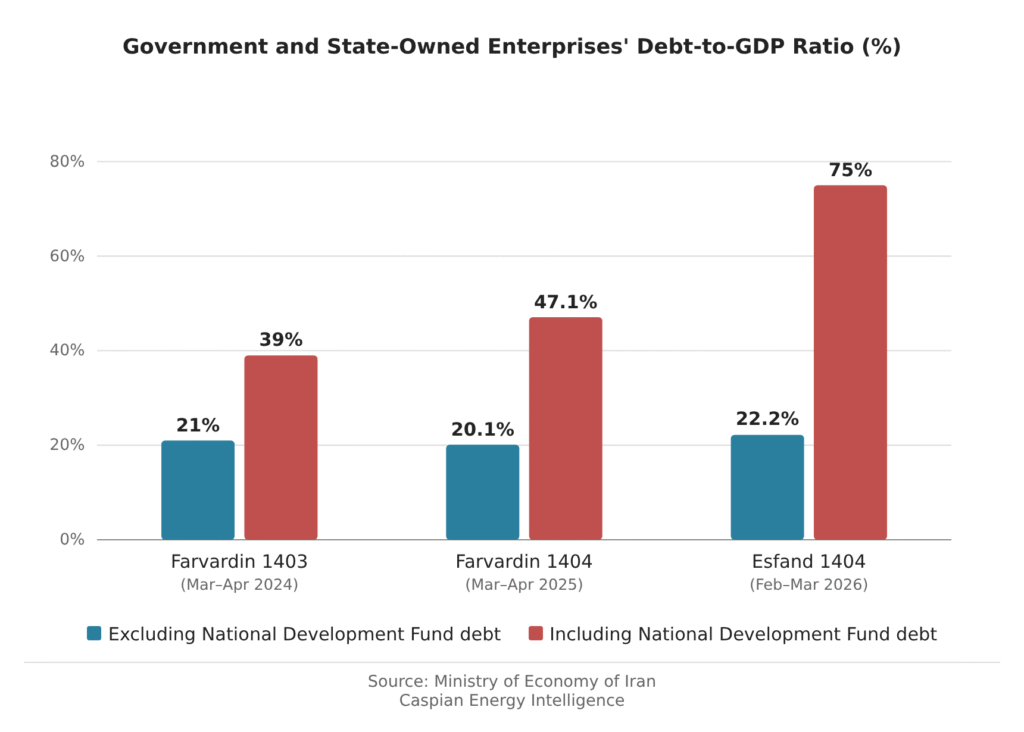
Excluding debt owed to the fund, combined government and state-owned enterprise debt has hovered around a fifth of GDP—running from 21.0% in early 2024 to 22.2% by early 2026.
Including it, the ratio surged from 39.0% in early 2024 to 75.0% by early 2026—nearly doubling in two years and sitting at more than triple the debt load without the fund.
Caspian Energy Intelligence
The International Monetary Fund estimated Iran’s general government debt at 35% of GDP last year and projects it will rise to 39%. In its October 2026 World Economic Outlook, the IMF projects average consumer-price inflation of 78.6% in 2026. The IMF figures come from a different source and method from the domestic data above and are not directly comparable.
Budget reviews by the Plan and Budget Organization show a similar distortion in the operating deficit. Driven by inflation, it surged more than ninefold in nominal terms to 932 trillion tomans between the 1397 fiscal year (March 2018–March 2019)—when U.S. sanctions returned—and fiscal 1404, even while shrinking as a share of GDP from over 3.7% to 2.62%.
The article was originally published on Iran Open Data