
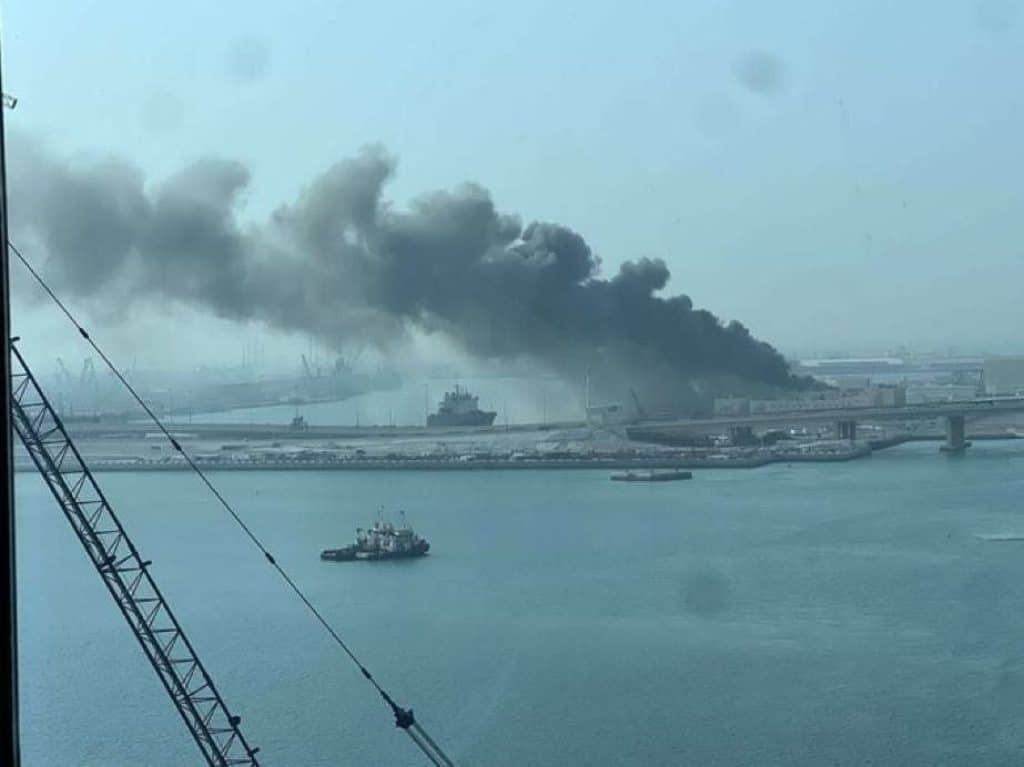
After suffering U.S. and Israeli strikes on its military and senior officials, the Islamic Republic launched a missile and drone assault against Arab states along the Persian Gulf.
Iranian forces launched roughly 1,500 drones and missiles at Iraq, Saudi Arabia, Kuwait, Bahrain, the United Arab Emirates, Qatar, and even Oman as of March 3, 2026. While anti-air and missile defenses intercepted most of these projectiles, confirmed impacts were reported on gas facilities in Qatar, Saudi Arabia’s Ras Tanura refinery, Kuwait’s Al-Ahmadi refinery, three oil tankers in waters south of Iran, and several commercial and industrial sites, including the Omani port of Duqm.
The consequences have been immediate. Qatar halted liquefied natural gas production and exports. Saudi Arabia’s Ras Tanura refinery, with a capacity of 550,000 barrels per day, has suspended operations. European and Asian gas prices have surged by 45 percent. The attacks have disrupted oil and petroleum product flows through the Strait of Hormuz, normally about 20 million barrels per day, pushing global oil prices up by 9 percent.
On March 1, 2026, Saudi Arabia warned that it would respond if Iranian attacks continue. President Donald Trump expressed surprise at Tehran’s decision to target regional states, noting that several countries had signaled willingness to align with Washington should the conflict escalate.
Given Iran’s unsuccessful record in several direct rounds of confrontation with Israel since 2024, Tehran appears to be attempting to pressure Arab states hosting U.S. bases. The apparent calculation is that these governments would press Washington to halt further strikes on Iran.
So far, however, the strategy has backfired. Rather than restraining the United States, Iran’s actions risk pushing Arab governments closer to Washington. Several European states have also begun signaling military support for their Arab partners.
On March 2, video footage circulated showing an explosion along one of Iran’s main oil pipelines. Iranian authorities did not comment. The pipeline connects oil fields in Khuzestan province—which account for roughly 70 percent of Iran’s crude production—to the Jask export terminal, Iran’s only oil outlet outside the Strait of Hormuz. If confirmed, the incident could be interpreted as a warning that bypassing the Strait would not shield Iran’s own exports from retaliation.
Iran itself is highly exposed to escalation in the Persian Gulf. More than 80 percent of Iran’s oil is produced in areas adjacent to the Gulf. According to estimates by the commodity intelligence firm Kpler, 96 percent of Iran’s oil exports last year were loaded at Kharg Island—a terminal located in the Persian Gulf.
Five major refineries—Persian Gulf Star, Abadan, Shazand, Lavan, and Bandar Abbas—together account for about 65 percent of output from Iran’s ten refineries, and all are situated in Persian Gulf-adjacent provinces.
Approximately 70 percent of Iran’s gas production comes from the South Pars field, shared with Qatar. Around half of the country’s petrochemical capacity is concentrated in the coastal province of Bushehr.
Beyond energy infrastructure, roughly 70 percent of Iran’s non-oil trade passes through Persian Gulf ports. The most important of these is Shahid Rajaee Port in Bandar Abbas, which alone handles more than half of Iran’s total imports and exports; one of its docks was reportedly targeted on March 1, 2026.
In practical terms, a substantial share of Iran’s energy and commercial infrastructure lies within reach of Gulf Arab states and their Western allies. Whether Arab governments join a military coalition against Iran remains uncertain. However, if attacks on their territory continue, the United States itself could target Iran’s energy and trade infrastructure in the Persian Gulf without requiring formal Arab participation.
The diplomatic fallout may prove even more enduring than the military escalation. The United Arab Emirates—Iran’s second-largest trading partner after China—has closed its embassy in Tehran. On March 1, 2026, foreign ministers of the Gulf Cooperation Council condemned what they described as Iran’s “unjustifiable aggression” and declared they would take all necessary measures to safeguard their security and stability. According to the statement, Persian Gulf states are actively reviewing potential responses to Tehran’s actions.
Iranian Foreign Minister Abbas Araghchi, without addressing the launch of roughly 1,500 drones and missiles toward regional states during the first three days of the war with Israel and the United States, insisted that “Iran continues to value good neighborly relations,” an attempt to project normalcy amid rapidly deteriorating ties.
Oman and Qatar, which for two decades have sought to mediate between Tehran and Washington—often engaging in quiet diplomacy favorable to Iran—may now reassess their assumptions. The message Iranian actions have transmitted is that in moments of confrontation, the Islamic Republic is prepared to subordinate even long-standing regional partnerships to its immediate military calculations.
In strategic terms, Tehran’s decision to widen the battlefield may ultimately weaken its own deterrence more than it constrains its adversaries.
The original article was published on Middle East Forum