
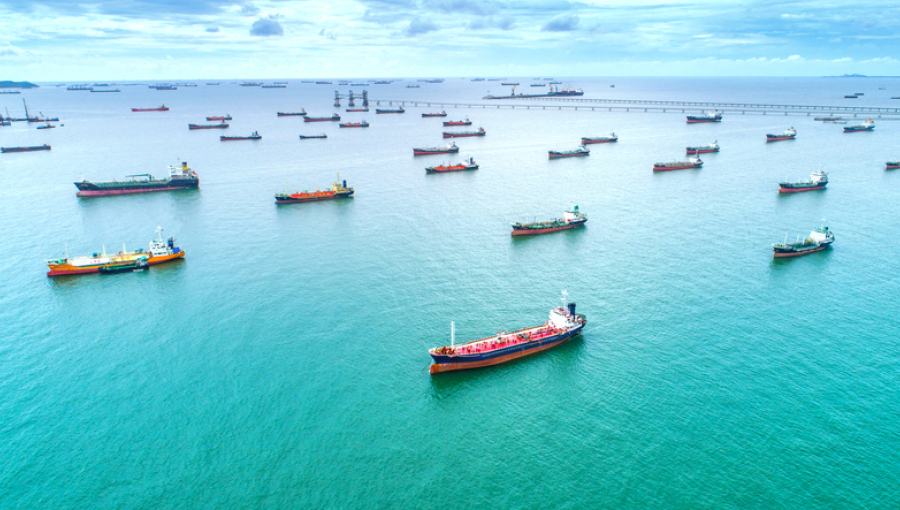
Roughly 170 million barrels of Iranian oil now sit in maritime limbo, circling the globe in what appears less a sanctions workaround than a strategic reserve. It’s enough crude to meet Japan’s energy needs for 50 days — or to fund Iran’s entire annual cash subsidy programme twice over.
IOD’s analysis of shipping and energy data suggests that amid fears of conflict with the United States or Israel, Tehran is converting the sea into storage — a hedge that comes at enormous economic cost.
This expensive accumulation comes amid escalating geopolitical tensions. U.S. sanctions have tightened after Iran’s harsh crackdown on protests, and the prospect of military retaliation by Israel or the United States is now being openly discussed in capitals across the region.
In such a climate, holding oil offshore may serve as both a revenue strategy and a wartime contingency. Yet the consequences are enormous: discounted sales, disappearing funds, and billions in foreign currency leakage.
The Cost of Caution
Iran’s oil output dropped by 81,000 barrels per day in January 2026, according to OPEC — a decline that mirrors the renewed “maximum pressure” campaign by Washington. China, Tehran’s only major buyer, scaled back deliveries to 1.1 million barrels per day, down from a 2025 average of 1.4 million.
Meanwhile, the number of sanctioned vessels has soared. In 2025, 86% of the tankers lifting Iranian oil were already under U.S. sanctions — up from 30% in 2024 — sharply curbing their access to ports, insurance, and financial services. As offloading windows narrowed, Iran’s oil piled up offshore. By January 2026, data from Kpler shows that 170 million barrels were in floating storage — a 130% year-on-year jump.
Keeping that oil on water is prohibitively expensive. Even using standard charter rates — roughly $100,000 per day for a very large crude carrier — storage costs exceed $8.5 million daily, or more than $3 billion annually. The true figure is likely far higher: most of the ships belong to the so-called “ghost fleet,” operators who charge premiums for taking on sanctioned cargo.
For context, $3 billion is 50% more than the Iranian government’s total annual budget for food and cash subsidies. It also equates to about 5 kilograms of red meat for every Iranian citizen — a useful benchmark in a country grappling with runaway food inflation.
Discounts, Disappearances, and Disarray
While the oil sits unsold, its value erodes. Based on a $60-per-barrel benchmark, the floating stockpile is worth over $10 billion. But one year of storage alone would consume a third of that amount — and that’s before accounting for insurance premiums, shell company markups, or cargo that quietly disappears.
Iran’s official export pricing worsens the bleed. To attract risk-averse buyers, Tehran now offers an $11-per-barrel discount — roughly 18% off market value. At current export levels, that pricing gap alone costs the state about $4.5 billion per year — more than double the government’s annual subsidy and voucher budget.
Even when sales go through, the revenues often don’t return. In February 2025, Ali-Akbar Pourbrahimi, former CEO of the National Iranian Oil Company, admitted that $11 billion in oil revenues had either been frozen in “corrupt trust accounts” or gone missing. A separate report by parliament’s budget integration commission found an $8 billion shortfall: of $21 billion in reported oil sales over eight months, only $13 billion entered public accounts.
With no imminent sanctions relief on the horizon — and nuclear talks in Oman restricted to technical matters — Iran’s crude remains effectively stuck. It is produced, shipped, discounted, and sometimes paid for. But more often than not, it is stored, stranded, or stolen.
For now, Iran’s oil economy is both a hostage and a hoard — trapped between diplomacy that leads nowhere and a conflict that may be coming.
The original article was published on Iran Open Data website.