
With a tentative ceasefire expiring and an incomplete lifting of Iran’s blockade of the Strait of Hormuz, the central question now is whether Iran will receive meaningful relief—particularly in the form of sanctions easing—or whether the United States will tie the lifting of sanctions to conditions such as curbs on regional activities or missile capabilities.
The current moment reflects the cumulative outcome of more than two decades of confrontation, sanctions, and nuclear escalation. These policies have imposed enormous economic costs on Iran, now compounded by a nearly two-month war whose effects are visible across the economy.
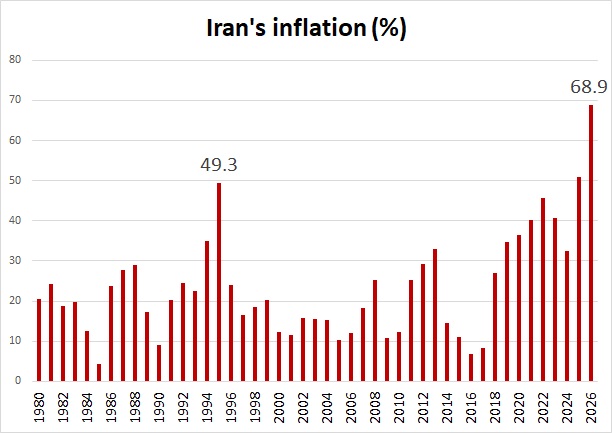
According to the International Monetary Fund, Iran’s real gross domestic product will contract by 6.1 percent this year, while inflation could reach 69 percent—levels that would mark one of the most severe episodes of economic instability in the country in decades. Even these figures may understate the depth of the crisis, given the International Monetary Fund’s reliance on official data.
In nominal terms, Iran’s economy is projected to fall to roughly $300 billion. This represents a dramatic decline in relative terms: Two decades ago, Iran’s economic output was broadly comparable to that of regional peers such as Turkey and Saudi Arabia. Today, it has shrunk to one-fifth the size of those economies and to less than half that of the United Arab Emirates and Israel.
The country’s nuclear investments further highlight this imbalance. About fifteen years after the Bushehr nuclear power plant came online, its cumulative electricity generation has yet to reach eighty terawatt-hours—equivalent to roughly $5 billion to $6 billion in value, a figure that does not even cover its construction costs.
Beyond macroeconomic indicators, the most immediate impact of the conflict is visible in the disruption of Iran’s industrial base. Key sectors—including petrochemicals, steel, electricity, and aviation—have all suffered significant damage during the recent strikes. Reports indicate that a large share of petrochemical and steel production capacity has been destroyed or rendered inoperable. These sectors historically have generated around $20 billion in annual export revenues, while serving as critical inputs for domestic industries.
The consequences already cascade through the economy. With domestic supply constrained, the government has moved to halt petrochemical exports in an effort to prevent internal shortages. Major production hubs such as Assaluyeh and Mahshahr—pillars of Iran’s petrochemical industry—reportedly have seen extensive disruptions, with recovery timelines ranging from months to years. Similarly, key steel production centers in Isfahan and Khuzestan are facing severe operational challenges.
These disruptions are feeding into broader industrial decline. The automotive sector, one of Iran’s largest manufacturing industries, is grappling with shortages of essential raw materials. Smaller industries face similar constraints, with reports of layoffs and production halts.
Iran’s energy sector, already under strain prior to the conflict, also has been hit. Official figures indicate a notable decline in operational power generation capacity, exacerbating an electricity shortfall that has persisted for years. During peak summer demand, the country requires far more capacity than is currently available, raising the likelihood of widespread outages.
The Energy Ministry has reported an 18 percent decline in the country’s electricity consumption, clearly indicating that industrial sectors—which account for 40 percent of power usage—are experiencing significant disruptions in their operations.
The aviation sector likewise has sustained heavy losses. About sixty passenger planes, one-third of Iran’s active commercial fleet, reportedly have been damaged or destroyed.
Taken together, these developments point to a critical inflection point. Military pressure, economic contraction, and industrial disruption appear to be converging to push Iran toward significant concessions.
Yet, the ultimate outcome remains uncertain. It is still unclear whether concessions would translate into tangible economic relief, or whether Iran will remain under sustained pressure despite scaling back key elements of its strategic posture. What is clear is that the costs of prolonged confrontation—economic, industrial, and geopolitical—are visible. The question no longer is whether Iran’s economy has been affected, but how lasting and transformative the effects will be.
The original article was published on Middle East Forum