
Iranian Vice President says damage to the country’s gas infrastructure during the 39-day war has more than doubled Iran’s gas deficit.
Esmail Saqqab Esfahani said that during the recent war, the country’s gas infrastructure suffered a loss of 55 billion cubic meters, reducing annual production from 297 bcm to 242 bcm annually.
According to him, when combined with last year’s 45 bcm gas shortfall, Iran is now facing a 100 bcm gas imbalance.
This massive gas deficit is equivalent to nearly twice Turkey’s total annual gas consumption. Despite holding the world’s second-largest natural gas reserves, Iran is grappling with a severe gas shortage due to delays in developing gas projects, extensive energy waste, and the failure to expand alternative energy sources.
Attack on downstream gas infrastructure
Late last year, Israel targeted several processing plants in the South Pars Gas Field. According to reports, gas-processing units in phases 3 to 6, 9, and 14 were struck.
It remains unclear exactly how much processing capacity was lost, but an analysis by the Iran Open Data Center, citing figures from the National Iranian Gas Company, indicates that the affected refineries have a combined annual processing capacity of 40 bcm.
The International Energy Agency has also estimated that the recent attacks likely affected 100 million cubic meters per day of Iranian gas supply — more than 36 bcm annually.
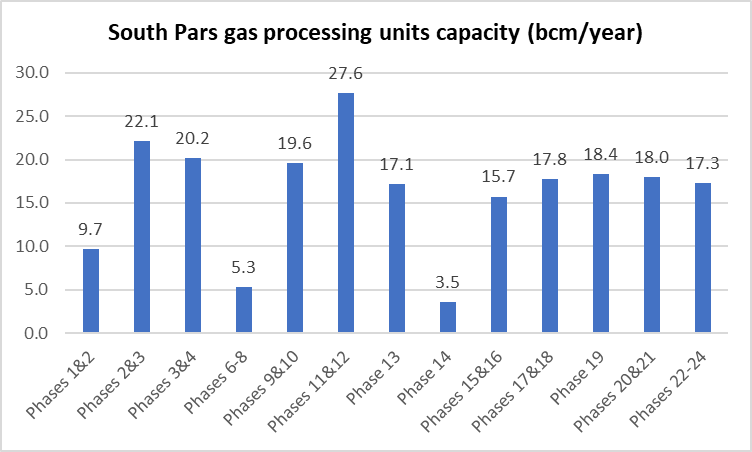
The key point, however, is that Israel did not target Iran’s upstream gas production fields; only gas-processing facilities were damaged. According to National Iranian Gas Company data, total refinery processing capacity even during peak demand is 10–15% higher than raw gas production. Therefore, Iran’s gas supply should not, in principle, have fallen by as much as Saqqab Esfahani claims.
Meanwhile, official Turkish data show that in the first month of the war (March), Iran increased gas exports to Turkey by 47%, reaching 832 million cubic meters — a figure that calls into question official claims of a dramatic decline in gas production.
There are also contradictions among Iranian officials regarding the impact of the refinery attacks. For example, Gholamreza Dehghan Naserabadi, a member of the Iranian parliament’s Energy Commission, claimed yesterday that damage to Iran’s gas facilities caused the country to lose one-third of its gas production capacity — roughly double the scale cited by the vice president.
Details of Iran’s gas deficit
Saqqab Esfahani, who also heads Iran’s energy efficiency organization, provided additional details about the country’s gas imbalance.
He said that last year Iran produced 297 bcm of gas, of which:
- 13 bcm was exported
- 40 bcm was consumed in what he described as “operational withdrawals”
- 243 bcm was delivered into the domestic consumption network
This compares with domestic demand of 285 bcm.
What the vice president refers to as “operational withdrawals” is in fact largely massive gas waste during production, transmission, and distribution, with only a small share used by production and transportation facilities themselves.
According to World Bank estimates, Iran annually flares around 23 bcm of associated gas from oil fields due to the absence of gas collection infrastructure at the production stage.
Iran has the world’s second-worst gas flaring record after Russia.
Data from the International Energy Agency further show that Iran loses more than 8 bcm annually through methane leakage from aging production and transmission infrastructure.
In other words, more than 31 bcm of Iran’s gas output is wasted every year during production and transmission alone — an enormous volume equivalent to more than half of Turkey’s annual gas consumption.
At the same time, the lack of diversification in Iran’s energy mix has pushed natural gas to account for more than 70% of total energy consumption.
For example, the combined share of hydropower, renewables, and nuclear energy in Iran’s final energy consumption is only around 1%.
This extreme dependence on gas, coupled with only marginal production growth, has caused Iran’s gas deficit to widen year after year.
The original article was published on VOA Persian