
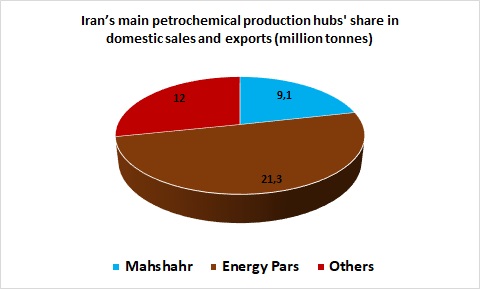
Iran’s petrochemical industry — the country’s second-largest source of foreign currency earnings after oil — is grappling with the fallout from the recent war, even though it had already fallen off its growth trajectory before the Israeli and U.S. attacks. The industry faces three major challenges: chronic feedstock shortages stemming from the country’s natural gas deficit, continued reliance on low-value basic products, and limited value added in its output.
Data from the National Petrochemical Company (NPC) and the Statistical Center of Iran show that growth in petrochemical production has stalled since the Iranian year 1402 (March 2023–March 2024). Output, which reached about 71 million metric tons that year, declined by nearly four million tons the following year, to 67 million tons.
The decline came despite an increase in the industry’s nominal production capacity. Last year, the nameplate capacity of Iran’s petrochemical complexes reached 103 million tons, but actual production totaled only 67 million tons — leaving roughly 36 million tons, more than a third of installed capacity, unused. Plants operated at an average of just 66 percent of capacity.
The primary reason for the gap is a shortage of natural gas feedstock. Official data show that around 72 percent of the feedstock used by Iran’s petrochemical plants consists of natural gas, mainly methane and ethane. As the country’s gas supply imbalance has worsened, disruptions in feedstock deliveries have become increasingly frequent — officials estimate that roughly two-thirds of production stoppages or output reductions at petrochemical complexes trace back to feedstock shortages.
Iran’s petrochemical industry generates approximately $13 billion in export revenues annually, accounting for nearly 22 percent of the country’s total non-oil exports. The sector consumes more than 68 million cubic meters of natural gas per day, with over 40 percent used as feedstock and the remainder as fuel — roughly 9 percent of Iran’s total natural gas consumption, a dependence that leaves the industry highly exposed to the country’s chronic gas shortages.
Reliance on Basic Products
Feedstock shortages aren’t the industry’s only challenge. Iran’s petrochemical sector remains heavily concentrated in basic, low-value products, while higher-value downstream output continues to account for only a limited share of the total.
According to NPC data, more than 54 million tons of hydrocarbons — including natural gas and petroleum products — are processed annually by Iran’s petrochemical complexes. Yet most of this feedstock is converted into primary petrochemical products, with only a small share moving further down the value chain.
The product mix illustrates the imbalance. Methanol alone accounts for 44 percent of Iran’s basic petrochemical production, while propylene — despite carrying more than twice methanol’s economic value — represents just 3 percent. By comparison, propylene accounts for around 15 percent of basic petrochemical output in Saudi Arabia, 18 percent in China, and 20 percent in the United States.
This weakness shows up in capacity as well as output: downstream industries account for only 2.5 percent of the total capacity of Iran’s petrochemical processing units, meaning the vast majority of investment remains concentrated at the earliest stages of the value chain.
The result is a low average value per ton — about $563, reflecting the industry’s dependence on basic products. NPC data show Iran produced about 42 million tons of marketable petrochemical products worth nearly $24 billion in the Iranian year 1403 (March 2024–March 2025).
War Damage
These structural weaknesses were compounded by the recent war, which damaged production facilities and supporting infrastructure across the industry. Over 39 days of conflict, Israel struck parts of the petrochemical infrastructure in Iran’s two main hubs — Mahshahr and the South Pars region — hitting power plants, utility facilities, and other supporting infrastructure in particular. No comprehensive assessment of the damage’s impact on production capacity has yet been published, and Iranian officials say the conflict disrupted both petrochemical exports and the domestic supply of certain products.
IOD’s analysis shows that the eight petrochemical complexes targeted in the Mahshahr region — Bandar Imam, Amir Kabir, Karoun, Marun, Rejal, Takht-e Jamshid, Bouali Sina, and Tondguyan — have a combined nameplate capacity of approximately 17 million tons, about one-sixth of Iran’s total installed petrochemical capacity.
In South Pars, several auxiliary facilities and power plants supplying petrochemical complexes in Asaluyeh and Kangan were also damaged, though it remains unclear how much of the country’s largest petrochemical hub’s operational capacity has been taken offline or otherwise disrupted.
Whatever the final damage assessment shows, it lands on an industry that was already running well below its potential — a sector where a third of installed capacity sat idle even before the war, held back by gas shortages and a product mix stuck at the bottom of the value chain. The war has not created these vulnerabilities; it has exposed them further.
The original article was published on Iran Open Data